CEOR programAdel Labs Linkby Adel Labs

Surfactant CEOR Project

Chemical EOR Application in Abu Dhabi Carbonate Reservoirs

Four research companions connect carbonate measurements, screening models and a literature evidence synthesis. Inspect a result, then open its source record. Two calculators connect trapping numbers and desaturation curves with retention-driven screening economics.

4
Interactive project companions
4
Manuscripts
2
Institutions
KU · ADNOC
KU-EXT-ADNOC-2022-8434000317
ADNOC grant

01

Chemical EOR in HTHS Carbonates

Carbonate reservoirs hold a major share of conventional oil and dominate the mature provinces of the Middle East. Waterflooding leaves a large fraction of that oil behind: carbonate surfaces trend mixed-to-oil-wet, so capillary forces hold residual oil in films and small pores, and heterogeneity limits how much of the reservoir the injected water contacts. Chemical EOR targets the trapped fraction by changing the fluid–rock physics. Surfactants cut oil–water interfacial tension by orders of magnitude so that trapped oil can mobilize; polymers raise the viscosity of the injected water to improve sweep; both are injected as engineered slugs driven from injector to producer.

The setting studied here allows little margin: reservoir temperatures at and above 100 °C and formation brines beyond 150,000 ppm TDS with high hardness — conditions that destabilize conventional surfactants, raise retention on positively charged calcite, and narrow the workable formulation window. The four projects below share one program question: what does it take — measured trapping thresholds, stable formulations, retention below the economic gate, and honest evidence on polymer elasticity — to make chemical flooding work in Abu Dhabi's carbonates.

Chemical slug train in section, injector to producer A sectional strip of reservoir between an injector on the left and a producer on the right. Chase water drives a polymer bank, which pushes the surfactant slug; oil mobilized at the slug front coalesces into an oil bank ahead of it. The injected volume slider advances all four fronts, and the oil bank reaches the producer at 0.73 pore volumes.
0.45 PV

Oil-bank front x/L 0.62 · breakthrough at 0.73 PV

Chemical slug train in section — chase water drives the polymer bank, which pushes the surfactant slug; mobilized oil coalesces into a bank ahead of the slug and reaches the producer near 0.73 PV. Drag to advance injection.

Interfacial Tension Reduction and Wettability Alteration

Capillary pressure sets the grip: Pc = 2σ cos θ / r for a pore throat of radius r. In an oil-wet pore the contact angle θ, measured through the water phase, exceeds 90°; cos θ is negative, and Pc opposes water entry — the rock holds its oil. Surfactants attack both terms at once. They cut the interfacial tension σ by up to five orders of magnitude, and they alter wettability, pulling θ back through 90°. Shrinking σ collapses the magnitude of Pc; crossing θ = 90° flips its sign, so the pore switches from repelling water to drawing it in, and the film-held oil releases from the surface. The same σ appears in the capillary number Nc = /(φσ): lowering IFT raises Nc by the same orders of magnitude, carrying it past the mobilization thresholds measured in this program.

Loading the three-dimensional scene

Drag to orbit

Trapping regime Below Nt,crit Nc 1.0 × 10⁻⁴ · released 0 / 18
1.0 × 10⁻⁴
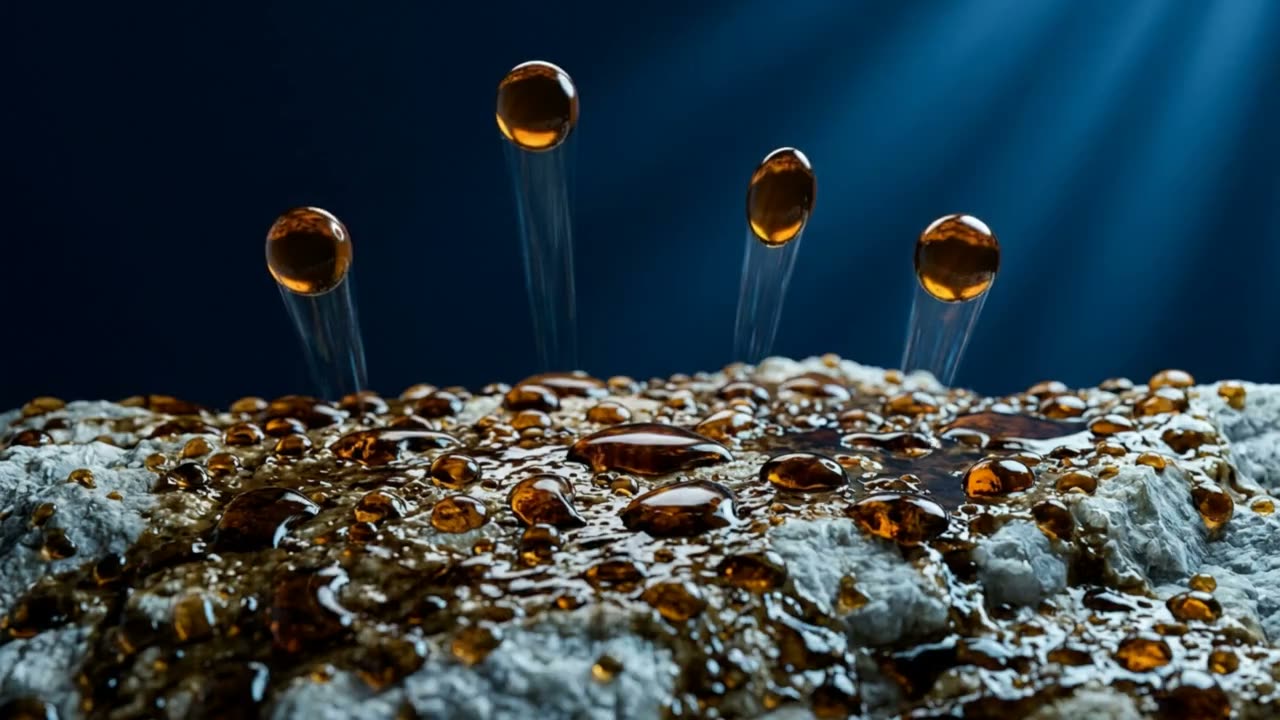
Trapped oil on an oil-wet carbonate patch — droplets stay pinned below the critical trapping number; mobilization begins at Nt,crit = 8.47 × 10⁻⁴ and the remaining droplets release as Nc rises. Drag to orbit.

Capillary pressure and capillary number — live

23 mN/m
150°

Oil-wet

0.40 cP

u = 1 ft/day (Darcy) · φ = 0.22 · r = 1 μm

Capillary pressure, Pc

Pc = 2σ cos θ / r

−39.8 kPa

Negative — capillary force holds oil

Capillary number, Nc

2.79 × 10⁻⁷

Water-wet sandstone onset 1.9 × 10⁻⁵
This program — carbonate Nt,crit range 8.47 × 10⁻⁴ – 2.23 × 10⁻³

02

Projects

Reports

01

Coreflood program · Interactive report

Critical Trapping Numbers and Capillary Desaturation

Coreflood measurement of capillary desaturation and critical trapping numbers in mixed-to-oil-wet carbonate cores under high-temperature, high-salinity surfactant flooding. The report carries the complete experiment records, a live computation engine, cross-core comparison, and field-rate scaling.

capillary-desaturation.adelstudio.dev
02

Screening framework · Interactive companion

Retention-Controlled Screening of Chemical EOR

A retention-controlled screening framework for surfactant EOR in HTHS carbonates: measured phase behavior, interfacial tension and wettability data, and a live retention-cost gate that prices retained surfactant against the screening budget.

retention-screening.adelstudio.dev

03

Screening economics · Interactive model

Techno-Economic Screening under Retention Uncertainty

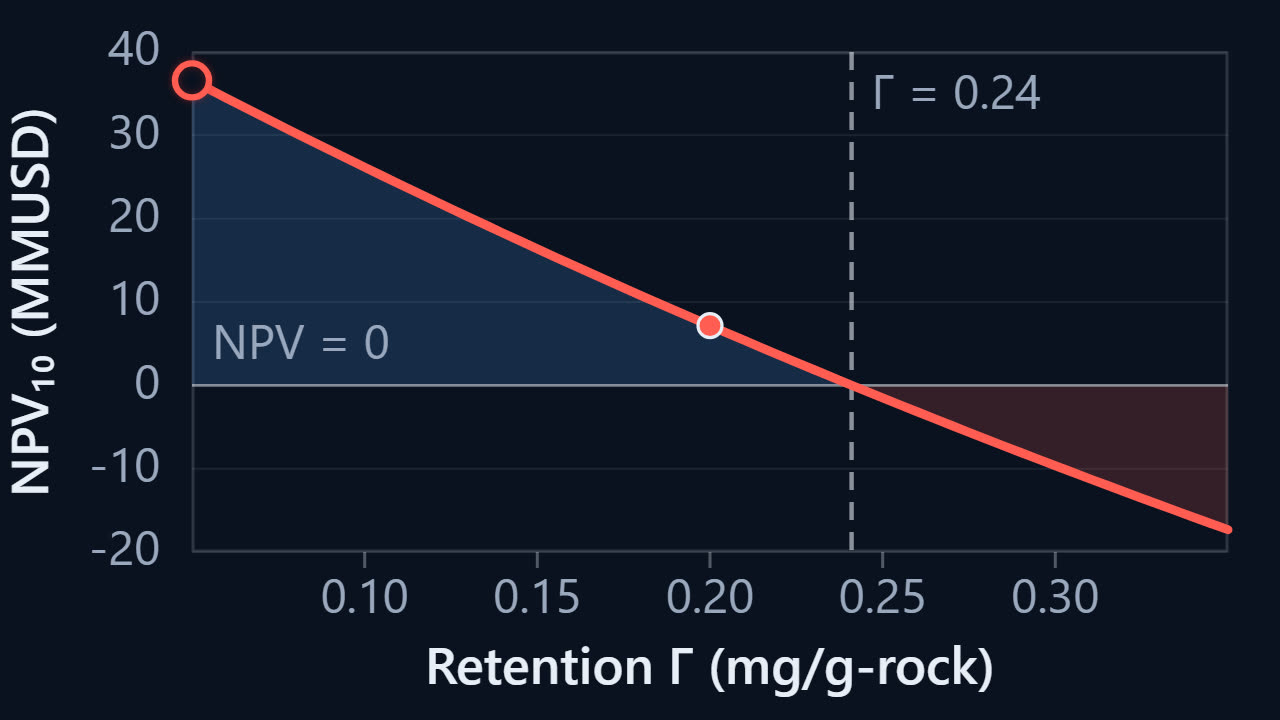
A discounted-cash-flow screening model that resolves surfactant dynamic retention into project value — NPV, rate of return, unit technical cost, and breakeven retention — on a basis calibrated to twelve screened corefloods.

retention-economics.adelstudio.dev

04

Evidence synthesis · Interactive companion

Viscoelastic Polymer Flooding and Residual-Oil Desaturation

A criteria-screened evidence synthesis of viscoelastic-polymer coreflood evidence for residual-oil desaturation, with measured carbonate injectivity bounds and a designed two-core experiment. The companion recomputes the classifier and estimator statistics live from the 49-contrast dataset.

viscoelastic-desaturation.adelstudio.dev

Live Calculators

Trapping Number and CDC Toolkit

The calculator computes capillary, Bond and total trapping numbers from entered rate, viscosity, interfacial tension and permeability, fits a capillary desaturation curve for the critical trapping number, and converts between petroleum unit systems.

cdc-calculator.adelstudio.dev

Chemical EOR Techno-Economics

The calculator resolves a user-defined flood design into chemical demand, unit technical cost, net present value and breakeven retention.

economics-calculator.adelstudio.dev

03

Manuscripts, Presentations and Data Packages

MS 00

Program Overview

Chemical EOR in Abu Dhabi carbonate reservoirs: the four studies read together as one chain of constraints, and where the margins sit.

MS 02

A retention-controlled screening framework for chemical EOR in high-temperature, high-salinity carbonate reservoirs

Manuscript prepared for submission to Petroleum Exploration and Development (KeAi Publishing), pending ADNOC review.

MS 04

Viscoelastic Polymer Flooding and Residual-Oil Desaturation: A Criteria-Screened Evidence Synthesis, Carbonate Injectivity Bounds, and Experimental Design

Manuscript in preparation for Petroleum Science (KeAi Publishing).

04

CEOR Team Members

Prepared by
Imad A. AdelSenior Petroleum Research Engineer
Principal Investigator (KU)
Dr. Emad W. Al-Shalabi
Co-Investigator (KU)
Dr. Waleed AlAmeri
Investigator (ADNOC)
Dr. Ali M. AlSumaiti
Co-Investigator (ADNOC)
Dr. Shehadeh Masalmeh
Project Members
Dr. Muhammad Mushtaq Dr. Anoo Sebastian Alvaro Hernandez Morales Aneena Kabeer Mohamed Efara